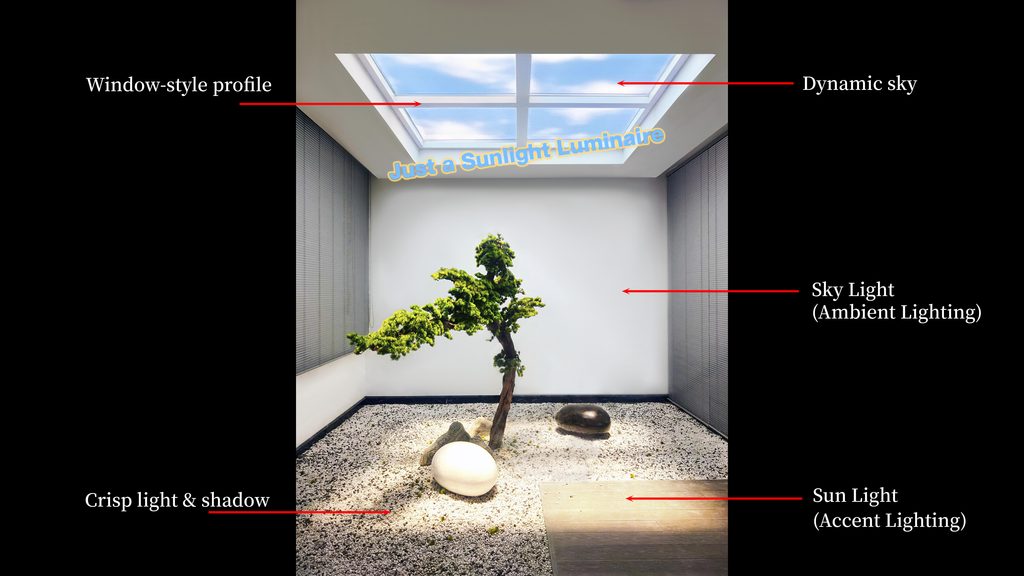
Why is the sky blue? Why are clouds white?
Why is the contrast between light and shadow so pronounced on clear days, creating deep shadows that appear tinged with blue?
Conversely, why are there almost no shadows on overcast days?
These familiar scenes are not simply the inherent colors of the sky; rather, they are optical results of sunlight traveling, direct lighting, and scattering in the atmosphere. Today, let’s explain it in simply and deeply, including the underlying logic of sky color, cloud formation, the depth of light and shadow, and the warm and cool tones of sunsets.
The way sunlight travels
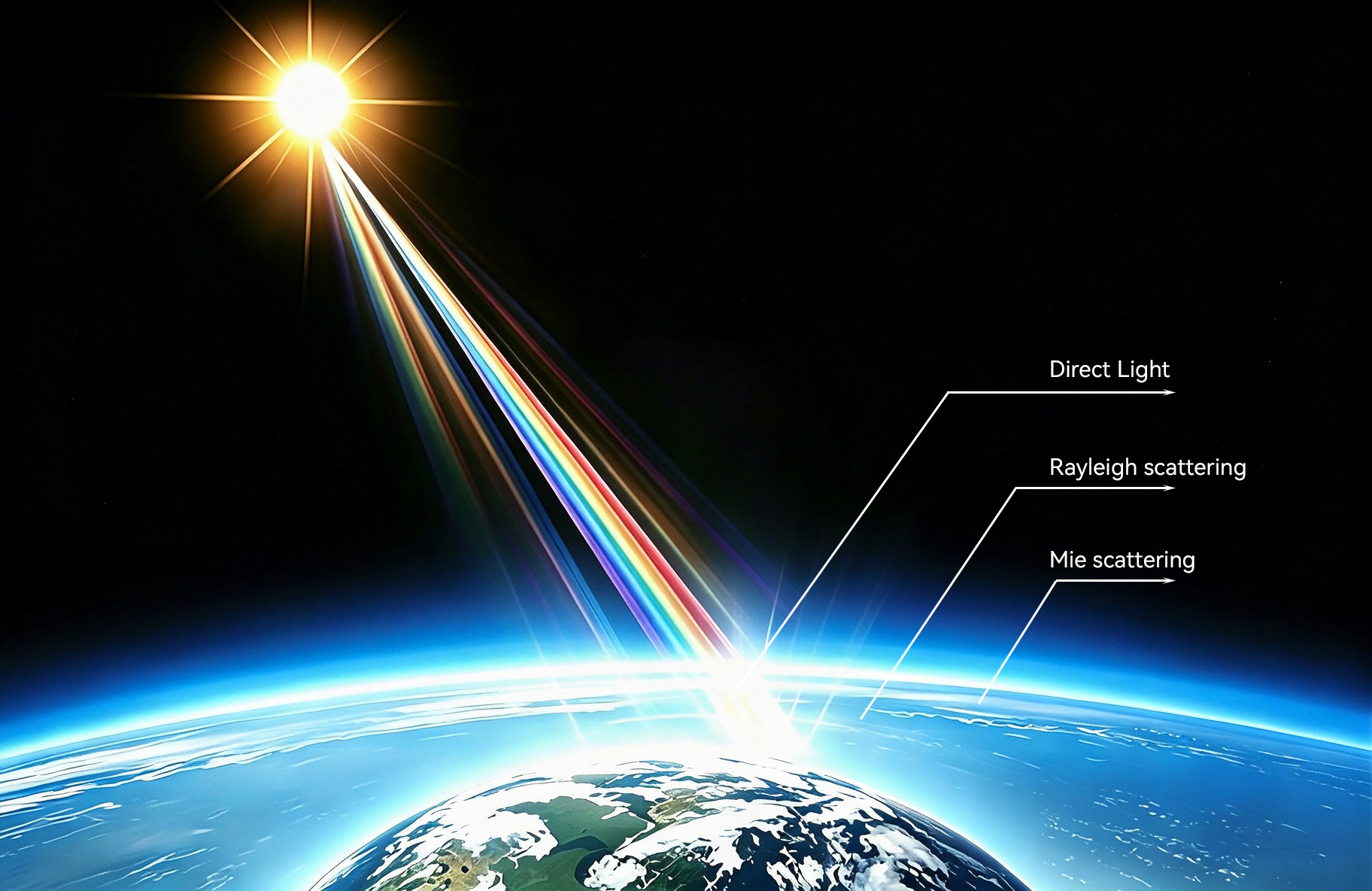
Sunlight is composite white light, a mixture of seven monochromatic lights: red, orange, yellow, green, blue, indigo, and violet. From the perspective of human visual perception, sunlight travels in the atmosphere falls into four categories: direct light, scattered light, absorption, and refraction. Their specific roles are as follows:
1. Scattering (Provides Ambient Light; Determines Sky Color and Shadow Tone)
Light strikes atmospheric particles and diffuses in all directions, illuminating the entire sky. Rayleigh scattering (particles: air molecules): preferentially scatters blue and violet light, dyeing the sky blue; Mie scattering (particles: dust and water droplets): uniformly scatters light of all colors, whitening clouds, fog, and haze.
2. Direct Light (Provides Directional Intense Light; Determines Light and Dark in the Visual World)
Direct light is the only light with a clear directionality. It provides the key light, with a unified direction and concentrated brightness. When blocked by objects, it creates a strong contrast between highlights and deep darkness—bright light patches, clear shadows, and three-dimensional contours all originate from direct light.
3. Absorption (Sunlight Energy Loss; Only Weakens Brightness)
Atmospheric molecules convert part of the light energy into heat, mainly affecting the invisible ultraviolet and infrared bands. Its effect on color differentiation in visible light is extremely weak; it causes only a slight loss of brightness and barely participates in constructing the colors and light-and-shadow effects we see.
4. Refraction (Light Position Shift; No Visual Color Effect)
Light bends due to uneven atmospheric density, changing only the apparent position of the sun (for example, we see the sun before it has risen above the horizon). Refraction does not change color or generate shadows, and is negligible at the visual level.
Without scattered light, the sky would be pitch black. Without direct light, the world would be flat gray.
Summary: At the visual level, refraction and absorption are only “supporting roles.” What truly governs the colors and light-and-shadow effects in our eyes is the coordinated action of direct light and scattered light (Rayleigh + Mie)—direct light gives the world clear light-dark contrast and three-dimensional contours; Rayleigh scattering lays down the blue tone of the sky; Mie scattering blends the whiteness of clouds and the soft gray of overcast days. All visual colors of natural phenomena are determined by combinations and variations of these three. Simply put: scattered light determines the basic hue of the sky (blue, white, gray), while direct light determines brightness and contrast. Without scattered light, the sky is pitch black; without direct light, the world is flat gray. Only when the two elements collaborate do they create the constantly changing visual world in our eyes.
Popular Science Explanation
01 Direct Light—Equivalent Collimated Light (Provides Directional Intense Light)
The sun is a giant sphere, but the Earth-Sun distance is as great as 150 million kilometers. From the perspective of the Earth’s surface, the sun’s apparent angular diameter is only 0.5, and its divergence angle is so small as to be negligible. Therefore, within the Earth’s atmosphere, direct sunlight can be treated as standard collimated light, providing directional intense light and visual light-dark contrast.
02 Rayleigh Scattering (Source of Blue Sky and Ambient Light)
Occurrence conditions: scattering particles (atmospheric nitrogen and oxygen molecules) are much smaller than visible-light wavelengths. Core rule: the shorter the wavelength, the stronger the scattering. Among visible light, blue and violet light have the shortest wavelengths and are easily scattered by air molecules in all directions, filling the entire sky; therefore, the sky appears blue.
03 Mie Scattering (Source of White Clouds and Ambient Light)
Occurrence conditions: scattering particles (small water droplets in clouds and fog) are comparable in size to visible-light wavelengths. Key difference from Rayleigh scattering: it is not wavelength-selective and scatters all colors uniformly.
Cloud and fog particles do not distinguish between long and short wavelengths; they uniformly scatter all colors—red, orange, yellow, green, blue, and violet. The seven colors recombine into pure white, so clouds appear pure white.
Q&A
01 Violet light scatters more strongly, so why is the sky not violet?
According to optical principles, violet light has a shorter wavelength than blue light and scatters more strongly. But why do we not see a violet sky? Three objective factors jointly determine this:
① In the sunlight spectrum, the proportion and energy of violet light are far lower than those of blue light;
② The high-altitude ozone layer strongly absorbs short-wavelength violet light, so little of it enters the lower atmosphere to participate in scattering;
③ The human eye is extremely sensitive to blue light and weakly perceives violet light. Ultimately, the sky appears a standard azure blue.
02 Why is noon sunlight white, while morning and evening sunlight is warm red?
This is mainly determined by the length of the light path.
At noon, direct sunlight passes through the thinnest atmosphere and the shortest path; a small amount of blue light is scattered into the sky, while most blue light mixes with red-orange light = pure white daylight.
At dawn and dusk, sunlight strikes obliquely along the horizon; the path is more than ten times thicker, blue and violet light are almost entirely lost, and only red-orange light reaches the ground = warm orange sunset glow.
Causes of Natural Phenomena
01 Clear Day: Causes of Blue Sky, Dark Shadows, and Cool Blue Shadows
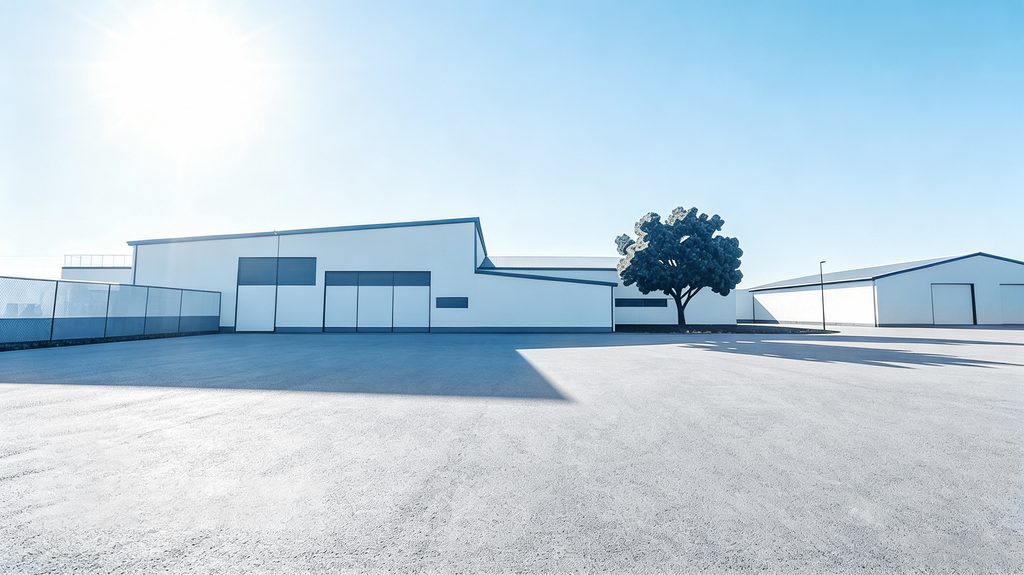
On a cloudless clear day, the atmosphere is clean and transparent. The overall light and shadow are jointly dominated by parallel direct solar light + Rayleigh-scattered blue light.
The sky appears clear azure because air molecules continuously scatter short-wavelength blue light; the diffuse blue light evenly fills the entire celestial dome. The ground light is bright and dazzling, and object shadows are deep and clear, because unidirectional parallel direct light is hard-blocked by objects, forming a strong light-dark contrast.Shadow areas completely exclude direct sunlight but can receive Rayleigh-scattered blue light falling from the entire sky. Therefore, on clear days, building shadows, eaves, and similar areas always carry a faint cool blue-gray tone.
02 Overcast Day: Causes of Gray-White Sky, Soft Light, and No Shadows
In overcast or foggy weather, a thick cloud layer completely covers the sky. Parallel direct sunlight is almost blocked, and the entire environment contains only diffuse soft light formed by Mie scattering, with almost no shadows.
Thin clouds appear pure white because cloud and fog droplets uniformly scatter all visible light, and the seven colors recombine into white light. In overcast conditions, the cloud layer is extremely thick; light penetrating the clouds to reach the ground is greatly reduced, and brightness drops sharply, creating a gloomy effect.At the same time, omnidirectional uniform diffuse light leaves no light-dark difference on objects, so shadows on overcast days are extremely faint or even completely disappear. Moreover, diffuse white light covers the blue scattered light in the air, and shadows appear a clean light gray-white.
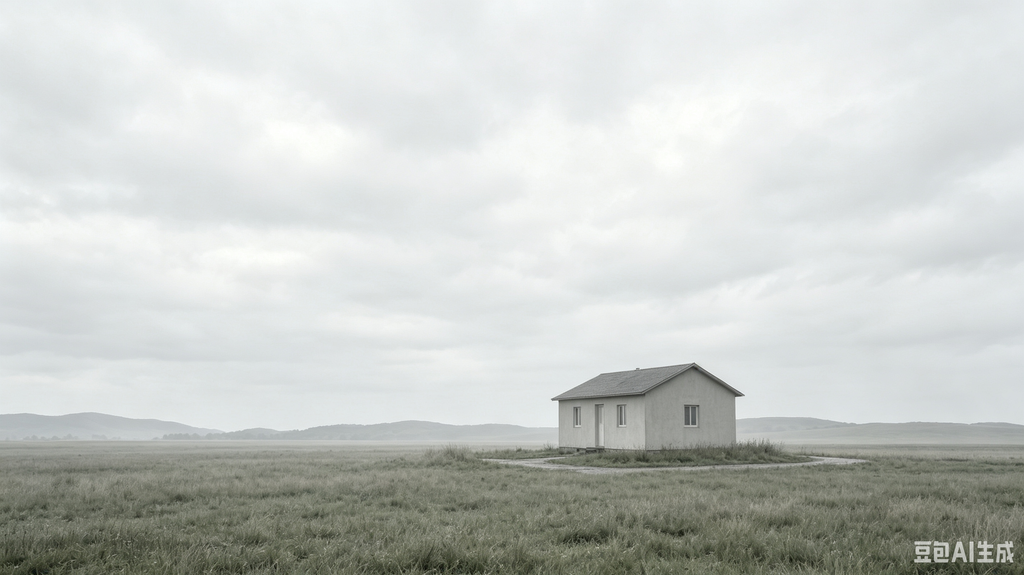
03 Dawn and Dusk: Warm Sunset Glow + Cyan-Blue Shadows with Warm-Cool Contrast
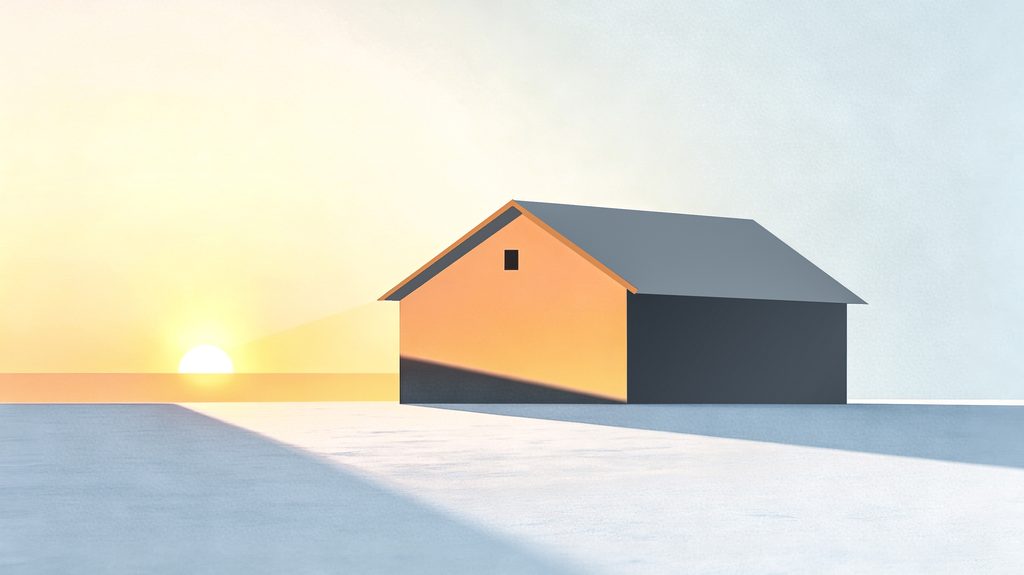
Sunrise and sunset are the times of the most extreme atmospheric optical contrast. All color changes still follow the wavelength rule of Rayleigh scattering.
Sunlight strikes obliquely near the horizon, and the transmission path is greatly lengthened, passing through an atmosphere more than ten times thicker than at noon. Along this extremely long path, all short-wavelength blue and violet light is scattered layer by layer and cannot reach the ground; only highly penetrating long-wavelength red and orange light successfully passes through the atmosphere, illuminating low clouds and the ground, forming beautiful morning and evening glow.
At this time, an aesthetically striking warm-cool light-and-shadow contrast appears: the sunlit sides of objects are flooded with warm orange and warm red direct light, showing warm tones; shaded shadow areas receive no warm direct light, only residual cool scattered blue light from the upper sky.
All the myriad brilliant colors of light and shadow in the world originate from the sun, the only natural light source—nature’s most moving visual gift to us. But, weather is always changing, and this is beyond our control. We cannot possess clear blue skies, gentle sunsets, or overcast and clear dawn and dusk anytime and anywhere.
Now that we understand the underlying principles by which sunlight passing through the atmosphere forms images, we cannot help asking: Can we recreate an “artificial sun” at home and reproduce natural light and shadow anytime and anywhere?
To highly restore the visual effect of real sunlight, the core is to replicate two key light components—direct light and scattered light (atmospheric absorption and refraction have weak impacts on human visual perception and need not be emphasized).
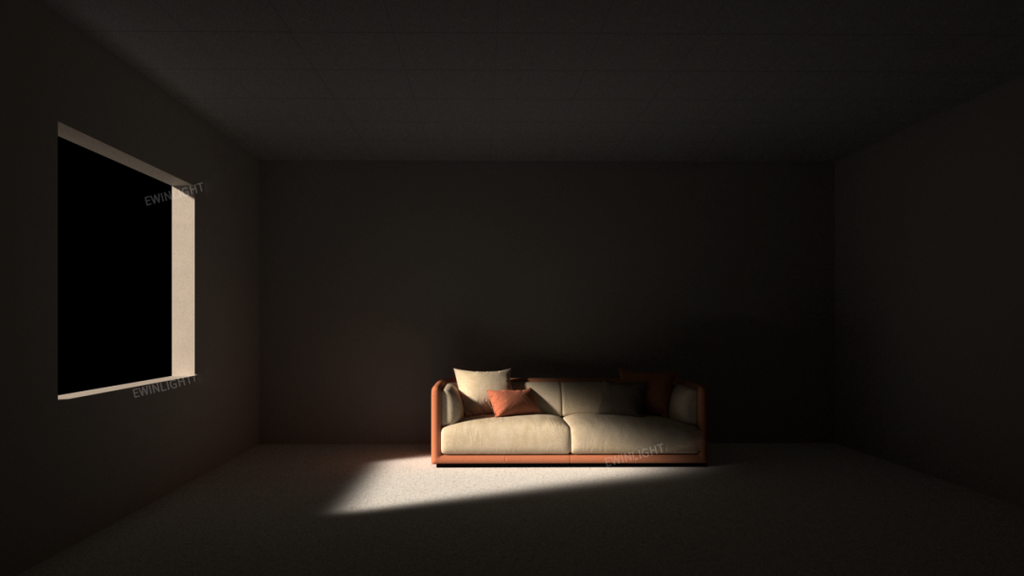
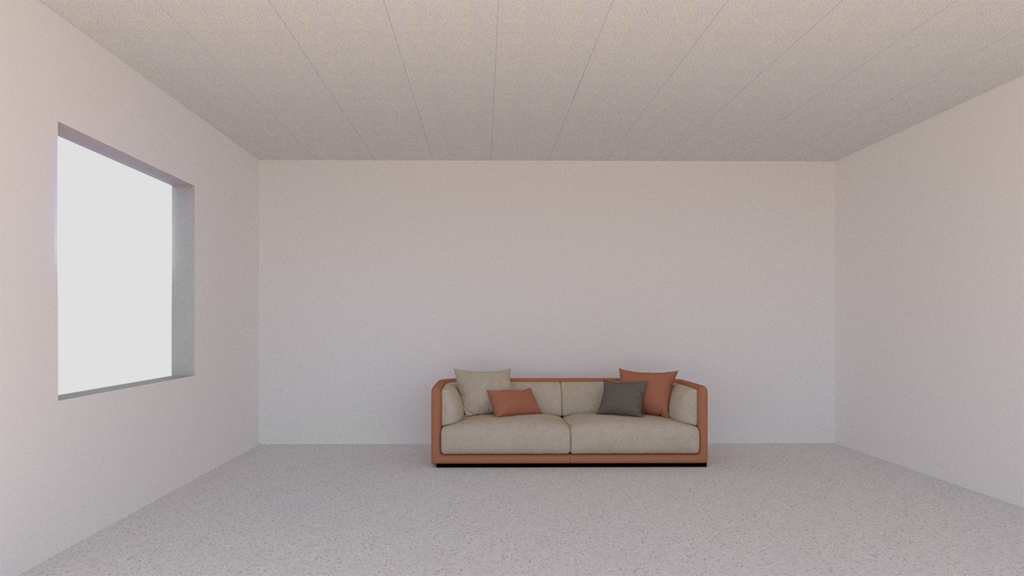
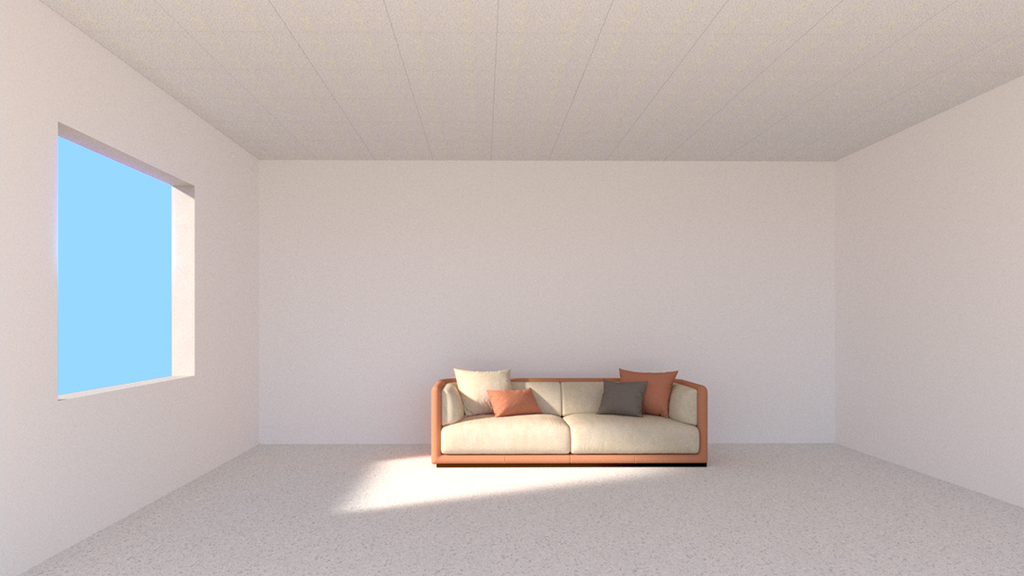
From this, we can understand the differences among all sunlight simulate products on the market:
Only a single scattered light source, with no parallel direct sunlight, Most have only sky-canopy Rayleigh scattered light and no parallel hard light simulating the sun; they cannot create bright light patches or distinct contours. They can only create local atmosphere, not serve as whole-house main lighting.
Most products can only simulate Rayleigh scattering and lack a Mie scattering light path, so they have no white-cloud effect. When dusk mode is turned on, the entire sky turns red-orange, whereas in reality the upper sky remains blue; they cannot restore the true sunset effect with warm-cool stratification.
Therefore, a qualified sunlight-simulating luminaire must simultaneously incorporate a dual light-path structure of direct light and scattered light. On this basis, if it can reproduce various natural scenes such as clear-day azure skylight, diffuse soft light of white clouds, uniform soft light of overcast days, and warm-toned sunset at dawn and dusk, it can fully Replicate